Finding a dream on Google Book Search

Friday, April 04, 2008 at 3:07 PM


By nature, I’m a loquacious person, so it should be no surprise that one of my favorite classes in college was a political science course on speakers and speeches. One of the textbooks, Lend Me Your Ears: Great Speeches in History (by one of my all-time favorite New York Times columnists, William Safire) became one of my most cherished literary discoveries.

In resolving a Trivial Pursuit dispute last week, I consulted it and came across Martin Luther King Jr.’s famous ‘I have a dream’ speech. It’s a powerful piece of oration, and after reading over it again, I was inspired to visit Google Book Search to find books containing his writings.

This time, I noticed the ‘Popular passages’ section, which makes it easy to find books that cite a particular block of text – such as speech by Martin Luther King Jr., for example. You'll find this feature to the right of book content on Google Book Search, as in the image below:


As you might expect, portions of this speech have been reprinted in quite a few places. My favorite discovery, though, was to find that the “I have a dream” speech found its way into an SAT prep book.

Martin Luther King Jr. delivered his ‘I have a dream’ speech in August of 1963. Less than five years later – and 40 years ago today – his voice was silenced. While we celebrate his life and memory each year on the anniversary of his birthday, the 40th anniversary of his death is a poignant time for reflection on the effect he’s had on America and the world. Read the full post 0 comments

Share:

Google Book Search now smells better

Tuesday, April 01, 2008 at 2:45 AM


In the process of scanning and storing images of pages from over a million books, we've benefited from the fact that the book is, generally speaking, a relatively uniform medium. Most books are a bound collection of flat pages, and the variations between volumes lie primarily in page size and number of pages. Our scanning processes work well for almost all of these titles -- we scan the images, clean them up, and present them for view on the Web.

But a small subset of books possess peculiarities that make them hard for us to archive. For example, we hit a snag when trying to scan pop-up books, like this one -- how would one properly present a pop-up book in a browser? We've faced similar problems in scanning and displaying Braille books and flip books.

However, today I'm pleased to let you know that we've made some headway with one type of volume we've struggled with in the past: books employing scratch-and-sniff technology. Using special equipment and tricky JavaScript, we're now able to capture some of the smells during the scanning process and then embed them in your web browser when you preview these titles in Google Book Search.

Intrigued? To start you off, here are a few aromatic examples:

We hope you enjoy the new feature, and we'll let you know when we get something working for those pop-up books. Read the full post 0 comments

Share:

In Search of Already-Found Books

Wednesday, March 26, 2008 at 2:10 PM


A few weeks ago, while I had an early version of the Google Book Search Library Gadget on my iGoogle page, I was suddenly transfixed by the fascinating cover of Shelters, Shacks, and Shanties. What was this book doing, hovering somewhere between my weather gadget and the latest news headlines?

One of the perks of product managing Google Book Search gadgets is that I get to play with them before anyone else does (except, of course, for the engineers who code them). The library gadget shows me books I've saved to my library, displaying them on my iGoogle page. I'd actually forgotten that, some months ago, I'd added this book to my library while browsing Google Book Search. Remembering my initial interest in the book, I dove back into it. I delighted at the instructions from this former Boy Scout about how to construct the most important priority in survival situations.

When I use Google Book Search, I find that I regularly add books to my library. I usually don't have the time to read a book right away, and adding it to my library is an easy way to remind myself of a book that I should check out later. Since my tumble into D.C. Beard's work, I've made sure to keep on adding titles to my library -- you never know when a book might strike your fancy a second (or third, or fourth) time. Here's what the fateful library gadget looks like:


So go on, surprise yourself! You can add it to your iGoogle Page here: Read the full post 0 comments

Share:

Preview books anywhere with the new Google Book Search API

Thursday, March 13, 2008 at 10:09 AM


Today we announced the release of a new API for Book Search. We're excited about this API because it makes it easy for users and other book lovers to connect with Google Book Search through a myriad of library sources, from their local library catalogs to their favorite book sites.

For example, using the API, a library can add a link to "View this book in Google Book Search" next to every book entry in its catalog for which we have a preview in our index. This means the library's patrons, whether in the library or online at home, can preview the book immediately via Google Book Search.

To see how you're most likely to encounter the API, check out the following examples:

At a local public library:
While searching the catalog of a university library:
Or while investigating books on your favorite online library cataloging resource:


We hope many more libraries and services will make use of the API. Our thanks to all the developers who moved so quickly to implement it. You can add it to your own site or web application, too - you'll find all the necessary information on this page.

*Implementations through Primo or SFX by Ex Libris
**Implementation through Scriblio
Read the full post 0 comments

Share:

St. Patrick's Day spectacular

Tuesday, March 11, 2008 at 2:24 PM


Ireland’s most famous day – Paddy's Day – is celebrated on March 17, in honor of (you guessed it!) Saint Patrick. On this day, which is believed to be the anniversary of St. Patrick’s death in the 5th century, Irish all over the world remember their patron saint, who is famous for two things: bringing Christianity to Ireland, and banishing all snakes from the island.

So if you walk around Dublin during the festival of St. Patrick's Day, you won’t find any snakes, but you'll probably find some of the symbols that typically decorate the streets to celebrate this date, such as the Shamrock. According to legend, this is what St. Patrick used to scare away the snakes of Ireland. You’ll also find plenty of green about, which has become synonymous with good luck for this day. Although it’s very likely that St. Patrick actually wore vestments of blue, green is so linked to the “Emerald Isle” that it is, without question, the de facto color of St. Patrick’s Day.

Five days of celebration culminate in an annual parade on the 17th of March, which always creates a carnival atmosphere, regardless of the weather. The theme of this year's parade is energy, which will certainly be displayed by participants like street performers and international marching bands. Parade aside, some of the most serious celebrations tend to happen in pubs, where young and old crowd together to enjoy a glass or two of the black stuff.

The Irish population is well represented around the world, making St. Patrick’s day a global celebration. New York’s parade is by far the biggest event in the world, with about 150,000 marchers and approximately 2 million spectators. Similar to the one in Dublin, it has street performers and infantry regiments leading the parade. This custom makes everyone feel Irish for a day.

Mark your calendar, because this coming Monday you might find a celebration near you. Happy St. Patrick’s Day! Read the full post 0 comments

Share:

Scalpel? Check. Google Book Search? Check.

Thursday, March 06, 2008 at 2:34 PM


One of the best things about working on Google Book Search is hearing all the imaginative and creative ways people are putting Book Search to work—ways we never could have imagined. Last year, for example, we heard from Jo Guldi, a graduate student studying 19th century British roads, and Erin McKean, a blogger who scouts Book Search for descriptions of Victorian dresses and dressmaking.

Last September, we came across a blog post by Dr. Joshua Schwimmer, a medical doctor who practices and teaches in New York City. We wouldn’t necessarily have thought of Google Book Search as a medical resource, so we were intrigued to read that Dr. Schwimmer had turned to Book Search as a teaching aid while in the emergency department with a group of students and residents.

We recently invited Dr. Schwimmer to share all the ways he’s found Google Book Search useful as a physician, and here’s what he had to say.


If you’re interested in reading more of Dr. Schwimmer’s thoughts on Book Search and medical education, you can read his full post here. And, as always, if you’d like to share your own story with us, let us know! Read the full post 0 comments

Share:

Your library, my library

Thursday, February 28, 2008 at 11:27 AM


A few months ago, we launched My library. We are always looking to improve this feature and make it more useful for book lovers, so we recently made a few tweaks to make your library feel more personal and to make it easier to share with others.

Here's an example of one of these improvements. The other day, I was reading the user reviews for The Undercover Economist and ran across one that I found particularly helpful. So I clicked on the link to "View Piaw's library" and uncovered a great variety of interesting books, both fiction and non-fiction.

I especially enjoyed Piaw's insightful book reviews, and so I made a mental note to come back to his collection for future recommendations. Conveniently, a recent improvement has made that easier to do. Under the user profile, we've added a button to "Add [user name] to my favorites".


When I click it, a new link appears in my own library. With this handy link, I can come back to check out Piaw's library at any time for more reading inspiration. Read the full post 0 comments

Share:

From the Mailbag: Report scanning errors in a cinch

Tuesday, February 19, 2008 at 9:47 AM


Welcome to another edition of "From the Mailbag," where we respond to emails from Google Book Search users. This week's message comes from Albert F., who writes:
"I can't find a way to report a scanned book in the Google repository that has page corruption (specifically a hand where text should appear). It would be nice to have some kind of link in the browser that specifically says something like Report a problem with this book rather than the generic 'general feedback' link."
Albert, it seems that you share an ESP-like connection with Google engineers, because we've been working on just this feature. You'll now find a link next to all book pages on Google Book Search which allows you to submit an unreadable page to our team for review. There's no need to fill anything out – when you click this link, we'll detect the issue with the page you're looking at and get on the case. Here's where you'll find the link:


So it's not exactly "Report a problem with this book," but hey, we're pretty close! We're always working to make sure that we're showing accurate scans for the books in our index, and this is an important step towards that goal. Don't worry, though – if you want to send us feedback as before, you can still do so from this page. Read the full post 0 comments

Share:

Celebrating Valentine's Day with Google Book Search

Thursday, February 14, 2008 at 10:54 AM


Today is Valentine’s Day, the most romantic holiday of all. If you read this and suddenly realize that you’ve forgotten to do something for a special someone, just remember the inscription on the back of the Hitchhiker’s Guide to the Galaxy: "Don’t Panic." Google Book Search can help you out.

Roses are a common Valentine’s Day gift, but if you want to put extra thought into your bouquet, look no further than The Language of Flowers. This link will take you right to the table of contents, where you can learn how to convey feelings like amiability (jasmine), the first emotions of love (lilac), or even the remarkably nuanced, “your qualities surpass your charms” (mignonette), through your florist. As you page through, keep an eye out for this 150-year-old book's beautiful full-color plate illustrations.

Let’s say you’d rather stimulate your valentine's senses through taste rather than smell. My own personal suggestion is to bake a cake (I’d go a step further and say that it should have as much chocolate as possible, but I grant that’s a personal choice). I dare you not to get excited about some of the recipes you can browse in the New Good Cake Book, or these cake decoration tips. And should you require any help whatsoever serving fair portions of the cake, Cake-Cutting Algorithms has 181 pages of mathematical analysis to make sure no one feels remotely cheated (no joke).

I’ll leave you with some of Charles Lamb’s amusing reflections on using the heart to symbolize love, looking at the phenomenon through a lens decidedly less metaphorical than literal:
“What authority we have in history or mythology for placing the head-quarters and metropolis of God Cupid in this anatomical seat rather than in any other, is not very clear; but we have got it, and it will serve as well as any other. Else we might easily imagine, upon some other system which might have prevailed for anything which our pathology knows to the contrary, a lover addressing his mistress, in perfect simplicity of feeling, ‘Madam, my liver and fortune are entirely at your disposal.’”
May your own liver have company this Valentine’s Day! Read the full post 0 comments

Share:

From the mail bag: Where can I get this book?

Thursday, February 07, 2008 at 6:03 PM


It’s time for another post “From the mail bag,” where we publish an email from one of our users and tackle it head-on. Here's a message from Bob in Arlington, Texas, who’s new to Google Book Search:
“I have found a book that I am interested in. It has been scanned. I have added it to My Library, but I cannot find out how to access or buy it. How can I do that?”
So you've discovered a great book, and after getting to know it a little bit, you've added it to your personal online collection. You feel ready to take the next step, but how do you seal the deal?

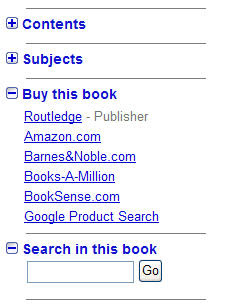
Take a look at the right hand column of the Google Book Search interface, where you'll see the ‘Buy this book’ heading:


We’ve partnered with a whole lot of publishers (over 10,000) to bring you previews of their books on Google Book Search. If the book you’ve found was submitted by one of these publishers, you'll often find that the first link takes you directly to their website. In this case, you could follow the first link to purchase the book directly from its publisher, Routledge.

You'll also find links that take you to various online bookstores. You’ll see different links depending on where you're located, since we try to make sure you get geographically relevant sites.

Finally, you’ll see a link to ‘Find this book in a library.’ We work with major union catalogs like WorldCat so we can show you which libraries closest to you have your book available.

That's not all, though -- when a book is no longer under copyright where you live, we work to ensure that you have the option to download a PDF copy, which you can print and read at your own pace.

And with that, we've finished our tour of ways you can get a print copy of an intriguing book. We hope it helps those of you who've chanced to run into a book a few times to "make the connection"... Read the full post 0 comments

Share: